Wednesday, May 30, 2012

I've Lost My Hippopotamus - A Poetry Break

INTRODUCTION
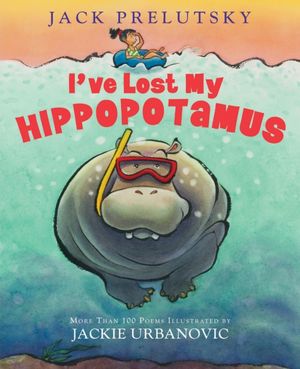
You should never lose your imagination. Ever. I read this poem while looking through poet's Jack Prelutsky's new book I've Lost My Hippopotamus and loved this poem because of the imagination and how it can inspire the reader to use his or hers to find out where is that silly hippo! Share this poem with a visual aid - yep, a photo or two of a hippopotamus!


POEM
I've Lost My Hippopotamus
by Jack Prelutsky 
I've lost my hippopotamus,
The situation's weird.
One minute she was next to me,
Then poof! she disappeared.
It's hard to lose a hippo,
For a hippo's truly huge-
I'm sensing something fishy,
Some unsavory subterfuge.
I've searched and searched with no success,
I've yet to find a clue
To her status or location,
I'm unsure of what to do.
If you spot a hippopotamus
Where usually there's none,
Please let me know, the odds are good
You've found my missing one.

EXTENSIONS


  • Ask the children where they think the hippopotamus could have disappeared to, and let them share their ideas.
  • Ask if anyone has ever had an imaginary animal, and let them share it.


BIBLIOGRAPHY
Prelutsky, Jack. 2012. I've Lost My Hippopotamus. Illus. by Jackie Urbanovic. NY, NY: Greenwillow Books (HarperCollinsPublishers). ISBN: 9780062014573.

Saturday, May 26, 2012

Benefits of Storytime

This time of the season can be slow "slow" time for many Children's Librarians. However, this is the calm before the storm that is called summer! It is also the time that we have to promote our storytimes and other programs to all the newcomers. I thought that I would share with you many points of importance of storytimes.

What is Storytime?
Storytime is a special literacy and educational based program for specific age groups!

  • Babies: Birth - 18 months
  • Toddlers: 18 months - 36 months (1.5-3 yrs old)
  • Preschool: 3 - 5 yr olds
  • Family: All ages

Storytime Activities
All storytimes can be different depending on what the library system and children's librarians like to do. Here are some activities that can be seen:

  • Songs
  • Rhymes
  • Movement Activities (egg shakers, scarves, parachute)
  • Flannel Boards
  • Stories (yes, we do read books at the storytime!)
  • Reading Together 
  • Crafts

Benefits of Storytime (for the Children)

  • Introduces Early Literacy Skills that will continue the children's learning development
  • Exercises listening skills
  • Connects images to reading and supports imaginations
  • Encourages socialization and respect among other children their own age (in the case of Family Storytime, for those who are younger)
  • Provides opportunity in learning how to take turns and follow instructions
  • Assists in developing fine and gross motor skills through program activities
  • Provides opportunities for independent activity

Benefits of Storytime (for the Grown-Ups)

  • Provides opportunity for quality time between caregiver and child(ren) to create a bond and trust
  • Provides an example of good oral reading kills to continue at home during family reading times
    • Children's librarians are generally dramatic readers and love use to use inflections while reading. We also ask the children questions about the story or illustrations. All good engaging elements to do while reading with a child!
  • Introduces new books, authors, songs and rhymes and other activities to do at home

One last benefit for everyone is... storytime creates and opportunity to visit your library!!!

Who would have thought that storytime was more than just listening to stories and singing some songs?!

Here ate WP-CC I do provide storytime outlines for everyone to have access to. There are many other children's librarians across the country that do the very same thing. Check the out sometime!

Check with your local library about their storytime programs and start having fun!

Friday, May 25, 2012

Nancy Clancy Super Sleuth

BIBLIOGRAPHY
O'Connor, Jane. 2012. Nancy Clancy, Super Sleuth. Illus. by Robin Preiss Glasser. NY, NY: Harper (HarperCollinsPublishers). ISBN: 9780062082930.

BOOK REVIEW
Our Fancy Nancy has grown up! In her first ever chapter book, Nancy and her best friend Bree, inspired by the famous literary detective herself - Nancy Drew, are now sleuths in need of a mystery to solve. Soon enough a mystery hits their classroom, and they dawn their totally professional trench coats and grab their magnifying glasses, which are quite fancy looking, and get to work uncovering the culprit. As with any great detective story, a top-secret code, complete with answer key, is a fun element for readers to discover and try out in their own mysteries. O'Connor's continues her excellent skill of weaving in new vocabulary words, as done in her previous Nancy books, which is parents will greatly appreciate. The black and white illustrations are just as fun as the previous books and make the book complete. As a whole, the book gives the readers the great element of still being fancy, but also being smart, polite, and adventurous, which is always refreshing. Nancy Clancy, Super Sleuth is a surefire, that means fabulously perfect, read for young readers who have graduated from the Beginning Reader books but need a friendly character to welcome them to real chapter books and new adventures! Looking forward to more in the series!

CONNECTIONS

  • Ask the children how they would have felt if their sibling was a suspect/culprit of a mystery.
  • Have the children create their own fancy detective outfits and have them solve a mystery! The mystery could be something as simple as a mystery memento project like the one in the story.
  • Introduce to the children another super sleuth, Nancy Drew. Read, together, one of her famous novels and do an activity based off of it!  

Thursday, May 24, 2012

Reading Comprehension for Homeschoolers

On the occasion I receive questions from new homeschooling parents about how to monitor the progression of their child(ren)'s reading. Many public school districts will use a system like AR and Lexile to measure the reading comprehension and advancement. Book levels are available online through their  respected websites. However, homeschoolers are generally not able to have access to the testing resources that come with these programs. How is a homeschooling parent to know how well their child is doing one may ask?

I am sure that many homeschooling families already know this, so this post is probably geared towards the new-to-homeschooling families. Either way, I want to point out that homescoolers have the wonderful freedom, in comparisons to many public schools, in what the children can read! Families, never take that for granted!


Here are a few of my recommended tips for the parents who want to see how their children are doing in reading and comprehension:

1. Let your child read whatever he or she wants. If child picks up a graphic novel, that is OK because GNs do require reading comprehension, but they will generally not appear on a AR and Lexile list. That is OK too! I generally tell parents that let them pick a graphic novel and then another "serious-yet-fun-and-interesting" chapter book of their choice (but, also, of your suggestion). This concept works for all levels with the exception of high school students. Compromise is a good term to use here. You do not know how many times I see disappointed looks on the faces of children who cannot read an awesome looking book only because it is not have the correct AR level and they "can't" read it. It actually hurts to see it. Trust me.
2. Be familiar with the books that your child is reading. Why? Because then you can ask them questions about it. What was it about? Who is the main character? What happened at the end? Did you like it? Why? Why not? Now, this is not the time to get every single detail and make you child feel like they must know everything. That's too much pressure. You just want to know how they are doing and if they're comprehending it.
3. If you want to test your child, check with your local public library to see what they have to offer. The State of Texas has the Texas STAAR for grade-level students and are for subjects like Reading, Mathematics, and Science. It just so happens that there are Texas STAAR coach books. The library system that I work for has these test guide books and the answer keys. I recommend these to a lot of students and parents because they can see and practice what the state requires students to know by a specified grade level. 
4. Look in to getting some SRA (Science Research Associates, Inc) Kits. As a former homeschool student (completed grades K-12), my siblings and I did SRAs. For those who are familiar with the older versions, we would pull out a card with a narrative on it, read it, and answered the questions then graded ourselves. We had two box kits: One that was really easy then another that was huge and color coded. The latter was especially meant for us when we were in middle school and high school. I may or may not have liked them back then, by I can definitely appreciate their value now. Publisher McGraw-Hill provides SRA Kits via their website. You can also check out your local homeschool curriculum sales to look into getting your hand on some of these! 


More Tips

If you would like some information on improving reading comprehension check out the WP-CC's page about R.A.D - Reading Aloud Daily. Reading Aloud has good benefits for comprehension!

Looking for example questions to ask about the book your reader just read? Look the post about Reading Comprehension - The Questions!

These are just a few tips that homeschoolers can take to mapping reading comprehension. Check with your local library to see what the children's librarian has up his or her sleeve to help you in your schooling.


Does anyone have other recommended tips for new-to-homeschooling families?


Wednesday, May 23, 2012

Will There Be Enough Room?!

I have been wanting to do a Chicka Chicka Boom Boom flannel board ever since I saw Miss Mollie over at What Happens in Storytime... shared hers. This month I finally got my chance when I had to do a presentation over Toddler Storytimes and this rhythm and rhyme storybook was one of only two flannel board options. If you must know, the other option was Brown Bear, Brown Bear What Do You See?. It is my goal to have a complete felt-only Brown Bear soon enough. That and a Where is the Green Sheep? one. Yes, you may get excited at that last one because I am!!!!

Anyway, back to the chicka chicka boom boom-ness. I traced the tree from the book with a sheet of tracing paper. I, then, traced it onto different color felts to create the varying colors of green. A hot glue proved to be rather handy in creating the tree canopy and adding the coconuts at the end because there were so many labels. The letters were created by using my library's die cuts. I can't wait until I let the children play with this one!

Chicka Chicka Boom Boom flannel board,
created by Dorothy WP-CC, 2012


Monday, April 30, 2012

Hot Dog - A Poetry Break

INTRODUCTION
So, it's baseball season again! This poem isn't necessarily about the classic American sport, but what you can :: eat :: during a ball game.... hot dogs! Yum! This poetry break requires some delectable hot dogs to eat - complete with all the trimmings! This poem would also work for a picnic session too.


POEM
Hot Dog
by Mordicai Gerstein

Dear hot dog..........................with relish and a blanket
snug as a puppy.....................of crimson ketchup.
in your bready bun,.............. .You are so fragrant,
I love you.............................. .I could
mustard..................................eat
up and down........................ ..you
your ticklish tummy,............  ..up!
and cover you up

EXTENSION
  • Have the children deck out a hot dog and eat it up (it's a must!)
  • Encourage the children to share what they love about hot dogs.
  • For the baseball season, have the children share what they like about the sport and what they eat at a game.

BIBLIOGRAPHYY
Gerstein, Mordicai. 2011. Dear Hot Dog. Illus. by Mordicai Gerstein. NY, NY: Abrams Books for Young Readers. ISBN: 9780810997325.

Saturday, April 28, 2012

Arbor Day - A Storytime Outline

In celebration of Arbor Day (April 28 or any last Friday of April),  I focused on trees for my last spring storytime. I had a great group of toddlers and a school group visit in my preschool program. We definitely had a lot of fun. Despite being a good number of books about trees, there was not many for the toddler age group. Thus, I focused also on birds.

T = Toddler Storytime
P = Preschool Storytime

BOOKS
Little Robin Redbreast: A Mother Goose Rhyme illustrated by Shari Halpern (T)
I chose this book cause it was great and simple. One little boy was super excited to see a kitty cat in the pictures!

Chicka Chicka Boom Boom written by Bill Martin Jr. and John Archambault and illus. by Lois Ehlert (T)
How can you :: not :: go wrong with this classic! One girl would say that we had to save the letters after they fell out of the coconut tree. We then had to go straight into singing the Alphabet Song.

The Busy Tree written by Jennifer Ward and illus. by Lisa Falkenstern (P)
This is a nice book about what type of animals live in a tree. The illustrations are a little dark in color so it did make it a little difficult to see small details. 

Mighty Tree written and illus. by Fick Gackenback (P)
This is a good book for the preschoolers and school kids. Trees can be used for products like paper and can be used for a Christmas tree, but it has a far more important job as being a home.

Fall is Not Easy written and illus. by Marty Kelley (P)
The children thought that this was hilarious!


SONGS & RHYMES
Open, Shut Them (T, P)
follow actions
Open, shut them
Open, shut them
Give a little clap
Open, shut them
Open, shut them
Lay them in your lap
Creep them, creep them up to your chin
Open your mouth wide, but don't put your fingers in!
Open, shut them
Open, shut them
Give a big clap
Open, shut them
Lay them in your lap.

Alphabet Song (T)
tune: Twinkle, Twinkle Little Star
A, B, C, D, E, F, G,
H, I, J, K,
L, M, N, O, P,
Q, R, S,
T, U, V,
W, X, Y, and Z.
Now I know my ABCs,
Next time won't you sing with me.

Way Up High in the Apple Tree
Way Up High in an Apple Tree
An apple smiled at me
I shook the tree as hard as I could
Down fell the apple
Mmmmm it was good

Additional verbs:
frowned, winked, laughed, blew a kiss, etc.
Inspiration source: King County Library System

Five Little Monkeys Swinging From a Tree (P)
Five little monkeys swinging from a tree (hold up five fingers and swing your arm)
Teasing Mr. Crocodile, "You can't catch me!" (but your hands to your ears like antlers!)
Along come Mr. Crocodile, (but your hands together and swim them around slowly)
As hungry as can be
And SNAP! (make your whole arms into a large crocodile mouth and snap your hands together like a big gulp!)

Four little monkeys swinging from a tree
Teasing Mr. Crocodile, "You can't catch me!"
Along comes Mr. Crocodile,
As hungry as can be
And SNAP!

Countdown to one monkey

One little monkey swinging from a tree
Teasing Mr. Crocodile, "You can't catch me!"
Along comes Mr. Crocodile,
As hunger as can be (still!)
And SNAP!
Along go Mr. Crocodile as fat as can be!

Touch Your Nose (T, P)
follow actions
Touch your nose
Touch your chin
That's the way this game begins
Touch your eyes
Touch your knees
Now pretend you're going to sneeze!
Aaachooooo!
Touch your hair
Touch one ear
Touch your two red lips right here
Touch your elbow where it ends
And that's the way this touch game ends.

FLANNEL BOARD
Way Up High in the Apple Tree (T)
I created a large tree to cover my flannel board by making a simple looking trunk and a fluffy tree canopy. For the rhyme I simply placed the number of needed apples to the tree top. While reading the rhyme I tried to promote the "one at a time / taking turns" side of fun by pointing at each toddler to get them to come up and pick and apple. It was mildly successful! The toddlers loved putting the apples back on the tree too at the end of the rhymes.

Five Little Monkeys Swinging in a Tree (P)
The children had a lot of fun doing this fun, especially during the SNAP! portion of the rhyme! I used a flannel board monkeys for this rhyme.

ACTIVITIES
Puppet Petting (T)
My library owns the Baby Birds in Nest puppet from Folkmanis. I walked around the group of toddlers so that they had an up close encounter with the birdies. Each one got to put the little heads. One precocious little girl kept on asking where the mommy bird was. It was super cute!

Eggs Shakers (T)
I pulled out the egg shakers one of my little regulars shout and jumped up. He loves the shakers!

CRAFTS
Tree Coloring Page (T)
The toddlers got another coloring page. In addition, they also had strips of green tissue paper to glue to the tree canopy. There was also a birds nest, to which I had a lot of questions about where the mommy bird was. They had to draw her in.

Miniature Trees (P)
The preschoolers got to make their own miniature tree from a toilet paper roll and construction paper. To make the green canopy stay up right all you have to do is cut two slits on either "ends" of the tube, and you just slip the paper right in. The children also got to add in a birds nest and a squirrel so that we highlighted the roll as tree=home to animals.

PICTURES

Way Up High in the Apple Tree, flannel board,
created by Dorothy WP-CC, 2012

Tree coloring page, Toddler Storytime Craft,
created by Dorothy WP-CC, 2012

Miniature Tree, Preschool Storytime Craft,
created by Dorothy WP-CC, 2012


MORE BOOKS
Leo's Tree written by Debora Pearson and illus. by Nora Hilb (T, P)
If I Were a Tree written by Dar Hosta (T, P)
A Tree for Me written by Nancy Van Laan and illus. by Sheila White Samption (P)
A Tree is Nice written by Janice May Udry and illus. by Marc Simont (P)
A Tree for Emmy written by Mary Ann Rodman and illus. by Tatjana Mai-Wyss (P)
The Apple Pie Tree written by Zoe Hall and illus. by Shari Helpern
Our Tree Named Steve written by Alan Zweibel and illus. by David Catrow (P, SA)
The Alphabet Tree written and illus. by Leo Lionni (P, SA)
Tree Ring Circus written and illus. by Adam Rex (P, SA)