Showing posts with label Bilingual. Show all posts

Friday, February 20, 2009

Major Poets and Awards: Love to Mama

BIBLIOGRAPHY
Mora, Pat. 2001. Love to Mamá: A Tribute to Mothers. Illus. by Paula S. Barragán M. NY: Lee & Low Books Inc. ISBN: 1584300191.

SUMMARY
Through a collection of selected poems moms and grandmas are loved and celebrated.

CRITICAL ANALYSIS
Written by Latino poets, which include Francisco X. Alarcón, Rigoberto González, Daniel A. Olivas, Mora has selected thirteen poems that pay tribute to the important ladies in the lives of children: moms and grandmas. The majority if the poems are free in verse; however, some do rhyme like Rigoberto González’s “Abuelita Wears a Dress.”

Written in the point of view of children all the poems focus on either a mom or grandma in various settings that range from outside of the school on the first day of class as in “I Helped My Mom Not to Be Late for Work” by Carmen D. Lucca to a traditional quinceañera to what it was like when a child’s two grandmas grew up in Cuba in Virgil Suárez’s “Las abuelitas.” The moods of the poems range from light humor as seen in “Abuelita Wears a Dress”:

Our jaws drop to our chest the evening
Abuelita steps out in a dress. Even the orange cat
glows it yellow eyes in surprise. Imagine that!
Abuelita waltzing out of the house in a shimmering

Gray gown. Abuelita only wears pants and jeans.
Because she works all day in the grape
fields we think she has no shape
outside a pair of old boots and green

flannel shirts.

to love like “Growing Up” by Liz Ann Báez Aguilar:

When I grow up,
I want to be a doctor.

M’ija, you will patched scraped knees
and wipe away children’s tears

But what if I become an architect?

M’ija you will build beautiful houses
where children will sing and play.

…

And Mami, what if I want to be like you someday?

M’ija, why do you want to be like me?

Oh Mami, because you care for people, our house is built on love,
you are wise, and your spicy stew tastes delicious.

The collection also includes poems of admiration like in Tony Medina’s “My Grandmother Had One Good Coat,” which tells of a story of how a child’s grandmother has a special black coat that she only wears to church or to the doctors and how the child saw a homeless woman without a coat and living underneath the bridge. When her grandma asks the child why her grandchild felt depressed she “went into her closet/and handed me her black dress coat/and said here put it in a shopping/bag you’ll find one in the broom closet/I don’t is that much anyway.”

Several of the poems also provide imagery and metaphor like in Mimi Chapra’s “Mi mamá cubana”:

When mi mamá cubana cooks arroz con pollo,
her smile is wider than a slice of watermelon.

Cutting green onions, the clucking tongue of mi mama goes clicktetty clack
Her silver bracelets slide up and down, jingling, jangling.

…

Closing my eyes I see palm trees swaying.
Seagulls circling. Haciendas, pink and green.

Still, sí sí, with eye open I taste salty, saffron Cuba.
Muchas gracias, mama cubana, for cooking up an island
in your tiny New York kitchen.

Another great element of the collection of poems is the use of the Spanish language. All of the poems use several Spanish words, along with “mama” and “abuelita,” that include words about food to games to parties, clothing, people and so much more. Unique from the others, Alarcón’s poem “My Grandma Is Like a Flowering Cactus” both has an English and Spanish version. To help the readers gain a better understanding of the words that are used, there is a glossary located in the back of the book that includes the word, pronunciation, and definition. The incorporation the Spanish language appeals to both English-speaking and Spanish-speaking readers because the words that are included are ones that are regularly scene many of the other bilingual books.

Barragán’s illustrations nicely compliment the poems. Presented in a two-page spread the poems are placed on a white section of the page and the illustrations fill the rest. The colorful and at times whimsical pictures of the moms, grandmas and children are stylized and are reminiscent of children paintings. Another wonderful element of the illustrations is the varying hair and skin colors of the people. Some moms, grandmas and children have lighter rather than darker skin. Some have brown hair while others have black hair. This goes to prove that not everyone is a like and don’t dress the same like in Christina Muñoz Mutchler’s poem “Mi abuela”: “Most grandmothers wear aprons/mi abuela like to wear her leather skirt.”

An introduction from Pat Mora to share why she decided to make this collection and how her mother, grandmother, and her aunt all played a pivotal part in raising her. Also, located in the back, there little biographies of all the contributing poets so that the readers and find further poetry books.

A perfect book to share around Mother’s Day or when a mom or a grandma’s birthday is coming, Mora’s collection is a must read.

CONNECTIONS
*Ask the children what do they love about their mom and/or grandma and why.
*Have the students compose a little poem and illustrate about what makes their mom and/or grandma important to them.

Saturday, March 8, 2008

Poetry for Children: Pío Peep! Traditional Spanish Nursery Rhymes

BIBLIOGRAPHY
Ada, Alma Flor and F. Isable Campoy. 2003. Pío Peep! Traditional Spanish Nursery Rhymes. Illus. by Vivía Escrivá and Eng. Adapt. by Alice Schertle. NY: HarperCollins Publishers. ISBN: 0688160190.

BOOK REVIEW
Pío Peep! Is a beautiful collection of traditional nursery rhymes collected from the rich Spanish-speaking cultures of Latin America and the American Southwest. The twenty-nine popular and loved rhymes capture the images of the world, its inhabitants, and the playful life that revolve around childhood. Through the simplistic flow of rhythm and rhyme that resonate off the page, rhymes like "Tortillas for Mommy": "Mommy like tortillas/steaming hot and yummy/Make them round and nicely browned/for Daddy’s hungry tummy" encourages the readers to recited aloud and share with each other. Through the talented work of adapter Alice Schertle the English versions are “poetic re-creations” rather than translations in order to maintain the charm and allure that is seen in the originals. Presented in double-spreads, the Spanish and English rhymes appear side-by-side and are surrounded by the soft and colorful watercolor and pencil illustrations that embody the imagery of the rhymes. Perfect for learning new games and finger-plays, for fun and educational way for learning a second language, and for reading any time of the day including bedtime, this bilingual book will be a welcomed addition to any school, library or home.

CONNECTIONS
*Read more Spanish-English poetry and finger-play books like the following three: Momá Goose by Alma Flor Ada and Isabel Campoy and Illus. by Maribel Suarez,, Tortillas para Mamá and Other Nursery Rhymes by Margot C. Griego, et al. and Illus. by Barbara Cooney, and Diez deditos = 10 Little Fingers & Other Play Rhymes and Action Songs from Latin America by Elisa Kleven and Jose-Luis Orozco.

Saturday, February 23, 2008

Traditional Tales: Just a Minute: A Trickster Tale and Counting Book

BIBLIOGRAPHY
Morales, Yuyi. 2003. Just a Minute: A Trickster Tale and Counting Book. San Francisco: Chronicle Books. ISBN:0811837580.

*Winner of the 2004 The Pura Belpré Medal for Illustration*

BOOK REVIEW
Grandma Beetle’s early morning had just begun when Señor Calavera, a hat-wearing skeleton, comes to her door saying that it is “time for her to come along with him” to the next life. But Grandma Beetle replies sweetly with “Just a minute” and explains that she has “just ONE house to sweep” before she goes. So Señor Calavera waits patiently and begins to count off in both English and Spanish the growing list of chores that Grandma Beetle must do before leaving with him. By the end of the day the frustrated skeleton learns that all of the work was in preparation for her birthday celebration, and that, along with her nine grandchildren, he was the tenth special guest. When the party is over and after she had kissed her grandchildren Grandma Beetle announces that she is ready to go with him, but discovers that Señor Calavera had gone without her but left a note saying that he had so much fun at her party that he can’t wait for the next one. With vibrant and richly colored illustrations that are delightfully simple yet with special detailed, Morales tells a traditional Mexican trickster tale of an old woman outwitting Death in a fun and never scary manner. Also serving as a beginning counting book with English and Spanish words, Just a Minute is book that can be enjoyed by readers of many ages.

CONNECTIONS
*Visit the author, Yuyi Morales, website and download the Señor Calavera puppet and mask to make.
*Read other trickster tales from around the world: A Tale of Tricky Fox by Jum Aylesworth and Illus. by Barbara McClintock, the Trickster tale series by Gerald McDermott, Love and Roast Chicken: A Trickster Take from the Andes Mountains by Barbara Knutson, and Trickster Tales by Josepha Sherman,
*Read other Yuyi Morales books like Little Night and Sand Sister.

Special Note: Yuyi Morales has written a new book that is set to be release on August 19, 2008: Just in Case: A Trickster Tale and Spanish Alphabet Book. This will be the perfect companion book to Just A Minute.

Friday, February 8, 2008

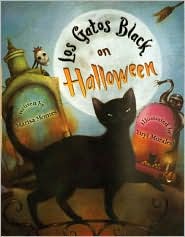
Intro. to Children and Their Lit.: Los Gatos Black on Halloween

BIBLIOGRAPHY
Montes, Marisa. 2006. Los Gatos Black on Halloween. Illus. by Yuyi Morales. NY: Henry Holt and Company, LLC. ISBN:0805074295.

*Winner of 2008 Pura Belpré Award for illustrations*

BOOK REVIEW

Under an “October’s luna, full and bright” a parade of witches, fantasmas, vampires, esqueletos, and corpses gather for a monster ball. In this creative rhyming story, Montes and Morales bring together Halloween and Dia de los Muertos with a blend of English and Spanish words that curve and weave through the warm and cool earthy and dark colors of the illustrations. With soft edges and textural brushstrokes, the spooky and surreal sceneries, characters and the playful text build the tension up to the very end where the “brujas are booging” and the wolfman is somersaulting to the “unseen dedos-fingers-play[ing] Forgotten music.” When three raps echo through the hall the readers learn of the most scariest things of all – “human niños at the door! Of all the horrors they have seen, the WORST are kids on Halloween!” With a glossary for pronunciation and meaning in the back for those new to Spanish, Los Gatos Black on Halloween is a fun and easy read for all to enjoy on a dark night or on a bright sunny day.

CONNECTIONS
*Read more books with a Halloween theme: Skeleton Hiccups by Margery Cuyler and Illus. by S.D. Schindler, Big Pumpkin by Erica Silverman and Illus. by S.D. Schindler, and The Little Old Lady Who Was Not Afraid of Anything by Linda Williams.
*Read books about Dia de los Muertos – Day of the Dead: Maria Molina and the Days of the Dead by Kathleen Krull and Illus. by Enrique O. Sanchez, Gift for Abuelita Celebrating the Day of the Dead/ Un regalo para Abuelita:En celebracion del Dia de los Muertos by Nancy Luenn, and The Spirit of Tio Fernando: A Day of the Dead Story/ El Espiritu De Tio Fernando: Un Historia Del Dia De Los Muertos by Janice Levy and Terese Mlawer.